2026 Rose-Hulman Grads Launch Multi-Axis 3D Printing Startup
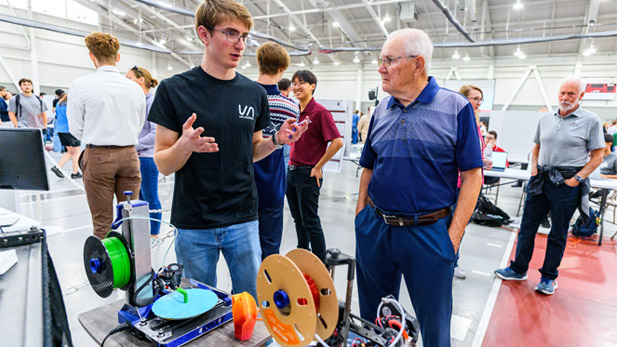
Recent graduates Alex Stedman and Philip Pounds are revolutionizing the 3D printing industry with their multi-axis printing startup, Unlayered, which enables creators to print without the use of supports.
As a 3D printer's nozzle moves along its print bed, it constructs, layer by layer, projects out of thin air. As Rose-Hulman students move through their education, they construct, layer by layer and opportunity by opportunity, innovation and entrepreneurship. For 2026 graduates Philip Pounds, Alex Stedman, and Alex Yim, the two processes are remarkably similar.
While still students at Rose-Hulman, Pounds and Stedman founded Unlayered, a startup pioneering multi-axis 3D printers. Now, as they develop the company full time, their revolutionary approach to 3D printing seeks to make it as accessible and simple as possible.
"The overarching North Star of the company is to build the best, most automated 3D printers that can basically manufacture anything," said Pounds, a mechanical engineering graduate.
Stedman, a computer engineering graduate, agreed, emphasizing that the team asked themselves, "What technology removes barriers to 3D printing the fastest?"
Traditionally, 3D printing irregularly shaped objects has required columns of layered filament to support any overhanging pieces. These supports then must be manually removed from the finished print, a tedious process that creates plastic waste, damages the quality of the print, and can lead to injury for the creator.
The nozzle on an Unlayered printer, however, can rotate around five different axes, enabling it to print freestanding structures with absolutely no supports.
"You can get better surface finishes on your parts so they're smoother. You can get higher strength of your parts, so they behave more like an injection of a traditional plastic part. You can save material on support structures," said Stedman.
The printer is designed to sit on a desktop, enabling users to create high-quality prints without the expense or resources required for large, industrial-scale machines. The team also built software to easily slice design files and prepare them for printing in just a few clicks.
"The status quo for 3D printing is just to 'design parts better', but that's just the sign of a bad process to have to learn all these extra steps," Stedman explained. "There's this whole unseen skillset in 3D printing…what if we can remove this requirement?"
Unlayered 3D was founded in February 2025, and opportunities at Rose-Hulman became the build plate for its success. Last year, the team added a layer of support, presenting at the annual Sawmill Society weekend before a panel of entrepreneurial alumni. They successfully earned a Sawmill Society ventureship, which provided funding to develop Unlayered prototypes. The ventureship also connected them with a network of mentors—a raft to help them navigate the waters of their entrepreneurial journey.
"Sawmill has incredible people who just pick up the phone and are so willing to talk to and mentor those students and startups," said Pounds.
He added that the mentors they connected with through the Rose-Hulman entrepreneurial ecosystem, including Sawmill Society, helped them infill their knowledge of business models and corporate governance. Rose-Hulman Professor of Engineering Management Tom James, PhD, also spent dozens of hours helping the team work through challenges and make key introductions.
Stedman noted, "It's one thing to get a check for some money. It's another thing to avoid a mistake that can cost you an order of magnitude more money."
By September, Stedman, Pounds, and Yim had a functional multi-axis prototype. Developing Unlayered became the team's senior capstone design project, enabling them to incorporate expertise from faculty mentors with their own and bring Yim to the team. Over the next several months, the team modeled and built a total of five designs, manufacturing their prototypes on campus in the Branam and Kremer Innovation Centers.
In spring, Unlayered blossomed. The team launched their pilot program, giving users the opportunity to apply to purchase their latest model. They also pitched at Sawmill Society Weekend again, this time before the Rose Angels — a group of alumni founders investing in established Rose-Hulman startups — and successfully attracted investors.
The Unlayered team added yet another layer to their success at the 2026 Rose Show, where they were awarded the William A. Kline Innovation Award. Named for Rose-Hulman's late dean of innovation, the award represents the Rose Show's grand prize and honors a team pushing the boundaries of possibility.
Unlayered is on the bleeding edge of innovation — literally. As Pounds was working on a different project and using a small knife to slice off the supports, the blade slipped and slit his finger, nearly severing a tendon. That trip to the emergency room and the resulting stitches confirmed what Pounds had long suspected: the future of 3D printing was in his hands.
The market agreed, and the team adhered to their dreams. Pounds, Stedman, and Yim have sought feedback from hundreds of users throughout every iteration, sending hundreds of cold-call messages or driving their model to potential clients over four hours away for a demonstration.
"We talked to users throughout the whole process. A lot of engineering-minded people will make something really cool, but then nobody cares about it," said Pounds. "We've talked to hundreds of users, and this is exactly what they've been looking for."
The founders sought feedback from industry experts in additive manufacturing, industrial automation, and 3D printing and have attended numerous leading trade shows, including Rapid+TCT and the Rocky Mountain RepRap Festival. Their product has also been featured by global influencers within the 3D printing community, including The 3D Printing Nerd, 3D Musketeers, 3D Printing Canada, and 3D Printing Doctor.
As their success takes shape, Unlayered extrudes innovation at every step. Much like a 3D printer turning spools of filament into finished projects, Stedman, Yim, and Pounds convert the technical and entrepreneurial skills they learned at Rose-Hulman into a flourishing startup, filling industry gaps one bit of plastic at a time.